
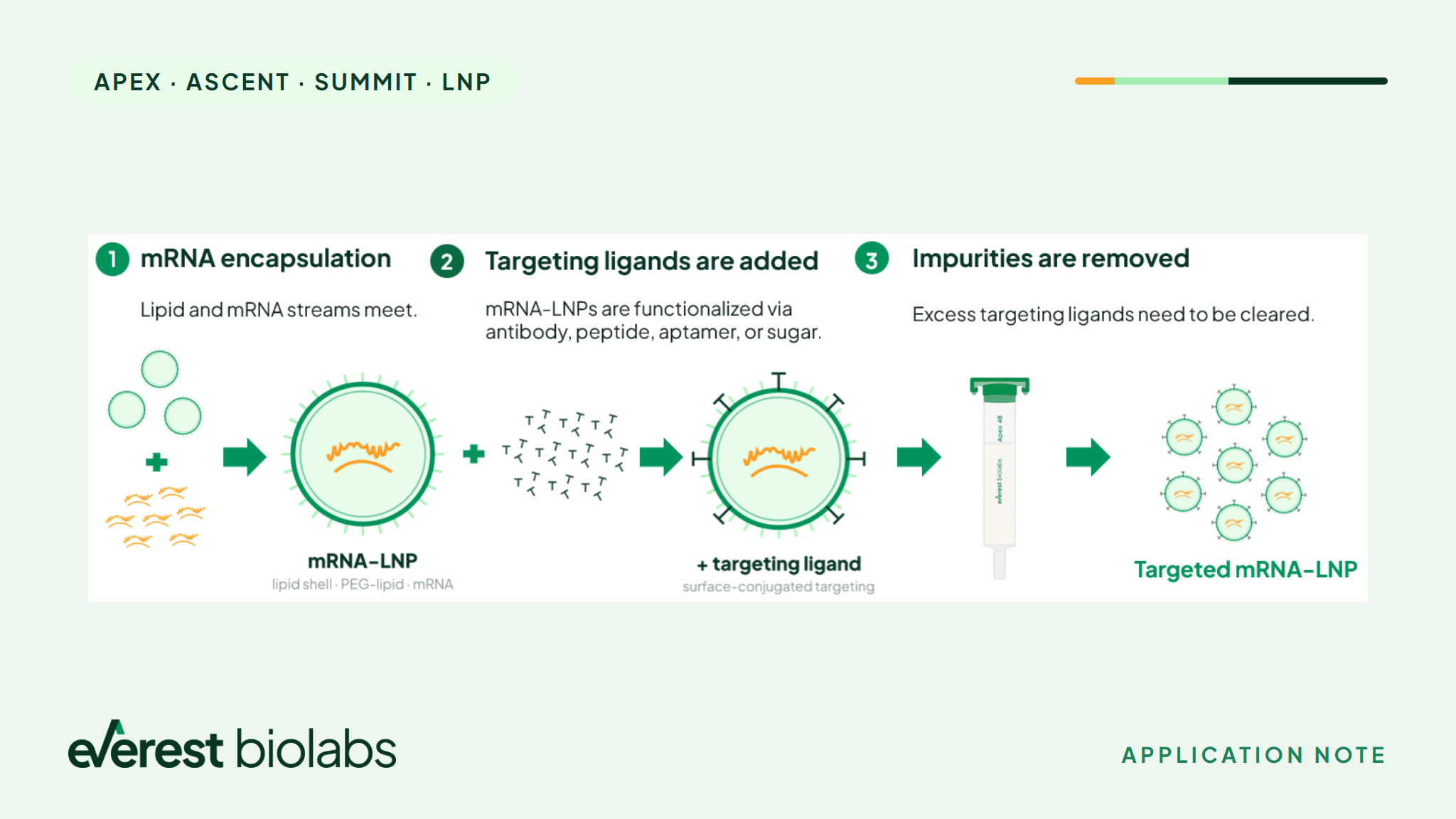
Lipid nanoparticles (LNPs) are the delivery vehicle for non-viral mRNA medicines. They encapsulate and protect fragile mRNA and carry it into cells, powering mRNA vaccines and a fast-growing class of therapeutics.1 Surface ligands such as antibodies, peptides, aptamers, and sugars now steer LNPs to specific cell types, extending mRNA delivery beyond the liver.2
Targeting adds complexity to LNP synthesis. After conjugation, excess targeting ligand remains in solution and must be removed before testing. Screening is a numbers game: you vary lipid ratios, ligands, and ligand densities across dozens of formulations, and each one needs clean, reproducible purification.
Key takeaways
- Apex 4B SEC columns gently remove more than 99% of free ligand without affecting particle size.
- The Ascent automates that cleanup for up to 8 formulations in parallel, with no hands-on time after loading.
- The Summit purifies and concentrates up to 48 formulations in a single unattended run, delivering screen-ready material.
Targeted LNPs require cleanup
Targeted LNPs (tLNPs) are produced using two common approaches. The targeting ligand can be integrated into the lipid before LNP synthesis, or the ligand can be conjugated after the LNP is created. The second approach is more common and gives greater flexibility in chemistry and ligand options. However, when the targeting molecule is conjugated to the lipid post-synthesis, unbound ligand remains in solution and must be removed before analysis and testing.
Size exclusion chromatography (SEC) separates particles by hydrodynamic size. tLNPs (~100–200 nm) are excluded from the resin pores and elute early, in the void volume. Free ligands such as antibodies, peptides, and aptamers enter the pores, travel more slowly, and elute later. No pressure, shear, or high g-force is applied, so particle size and integrity are preserved.

SEC: the workhorse for LNP cleanup. Gentle, size-based separation that purifies tLNPs without changing their size distribution.
Gravity SEC is already the field standard
Gravity-fed SEC on cross-linked agarose is the accepted way to remove unbound ligand from targeted LNPs. The approach was established for antibody-conjugated mRNA-LNPs in 20183 and has since become routine across the field for targeted LNPs.4,5,6
Sepharose CL-4B sits in the size range that separates intact LNPs from free ligands such as antibodies, peptides, and aptamers. Particles are excluded from the pores and elute in the void volume, while free ligands enter the pores and come off in later fractions.7
SEC does the purification, but one manual column at a time cannot keep pace with a screen. Apex columns and plates run the same CL-4B separation in a prepacked, lot-validated format, and the Ascent and Summit run them 8 and 48 at a time.
Apex SEC separates tLNPs from free targeting ligand
On Apex 4B columns, you can recover more than 85% of tLNPs while removing more than 99% of free protein. We spiked mRNA-LNPs with an anti-CD3 antibody, loaded the mixture onto an Apex 4B column, and collected 11 fractions. Total RNA (RiboGreen) tracked the LNPs; total protein (BCA) tracked the free antibody. Apex columns and Apex 24-well SEC plates both accept 0.1–1 mL of sample.
The two populations resolve cleanly (Figure 2A). LNP RNA elutes in fractions 1–3 and peaks at 220 ng/mL in fraction 2. Free anti-CD3 stays at background through fraction 6, rises from fraction 7, and peaks near 17 µg/mL in fractions 9–10, well clear of the LNP pool.
Pooling fractions 1–3 gives a quantitative picture (Figure 2B). IgG drops from 152 µg/mL in the input to below the detection limit, a removal of more than 99%. RNA recovery in the pool is 86% of a 438 ng/mL input. The particles themselves are unchanged: DLS size distributions of the input and the Apex 4B eluate overlay almost exactly, with no aggregation or loss of the main population (Figure 2C).


86% RNA recovery · >99% IgG removed · size distribution unchanged
The same cleanup prepares labeled LNPs for single particle analysis. Counting the number of ligands per particle is critical to understanding the degree of labelling and the effectiveness of the LNP. This means staining the targeting ligand and measuring single particle fluorescence. Nano-flow cytometry is increasingly being used to analyze tLNPs.9 Nano-flow cytometry resolves single particles, so any unbound secondary labels in the sample are a direct interference: they raise background and can create false positive events. SEC cleans the sample, so you are measuring LNPs and nothing else.10
Ascent: eight formulations in parallel
The Ascent instrument purifies up to 8 formulations at once, in about an hour, with no hands-on time after loading. The workflow is fully customizable to fit your lab. Program the run on the touchscreen (column type, wash and discard volumes, number and volume of fractions), load your samples, and walk away.
- Parallel runs. Run or wash up to 8 columns side by side, ~1 h for 8 samples.
- Open platform. Compatible with Apex columns as well as third-party and home-packed columns.
- Precise fractionation. Collect up to 12 fractions per column with programmable collection sequences.
- ColumnSaver. Buffer drips slowly onto idle columns so they never dry out while the run waits for you.
Concentration on the Ascent. For low-volume downstream assays, collect the tLNP fractions directly into centrifugal concentrators.

Summit: clean and concentrate 48 formulations at once
The Summit instrument purifies and concentrates up to 48 tLNP formulations in a single automated run. It uses Apex 24-well SEC plates or Apex columns, so conditions you develop on columns transfer directly to the Summit; plate-based SEC has been shown to perform equivalently to column-based SEC.8
- Load 1–48 tLNP formulations. Vary lipid ratios, ligands, and ligand densities side by side, from individual Eppendorf tubes or a 96-well plate.
- Summit runs the SEC. Automated, parallel cleanup of every formulation, from column washing to sample addition and post-SEC concentration.
- 48 purified tLNPs. Excess ligand removed and particles concentrated, delivered to individual tubes or a 96-well plate, ready for screening.

Automated concentration on the Summit
SEC dilutes your sample; the Summit gives the concentration back without the manual step. It collects tLNP fractions into 24-well regenerated cellulose concentration plates and concentrates them on deck. Volume is measured with an ultrasonic sensor so you can choose your final concentrated output volume, reducing the variability seen in centrifugal filters. Starting from a pooled SEC input of 121 ± 1 ng/mL (n=3), the Summit raised total RNA to 765 ± 66 ng/mL, a 6.3-fold increase, and returned 75% of the input RNA mass. Run side by side, Amicon Ultra 10 kDa centrifugal filters reached 692 ± 112 ng/mL (5.7-fold) with 73% recovery, so the Summit matches manual concentration while running unattended and with tighter run-to-run spread. Particle size is unaffected: DLS distributions before and after concentration overlay almost exactly (Figure 5).

Choose your scale
| Metric | Manual Apex column | Ascent | Summit |
|---|---|---|---|
| Formulations per run | 1 per user | 8 | 4–48 |
| Hands-on time per run | ~70 min | ~5 min | ~10 min |
| SEC format | Apex column | Apex or third-party | Apex 24-well SEC plate |
| Fully automatic wash | No | Yes | Yes |
| ColumnSaver | No | Yes | Yes |
| Concentration | Manual, off-line | Centrifugal concentrators | Fully automated, on deck |
| Sample input / output | Tubes | Tubes | Tubes or 96-well plate |
Conclusion
Every targeted LNP formulation needs cleanup before it can be screened, and screening campaigns run tens to thousands of formulations. Apex SEC removes more than 99% of free targeting ligand while recovering 86% of tLNP RNA and preserving encapsulation and size distribution. The Ascent runs that cleanup on 8 formulations in parallel, and the Summit purifies and concentrates up to 48 at once. From your first conjugation to a full formulation screen, Everest gives you clean, concentrated, screen-ready tLNPs.
References
- Hou X, Zaks T, Langer R, et al. Lipid nanoparticles for mRNA delivery. Nat Rev Mater. 2021;6:1078–1094.
- Dilliard SA, Siegwart DJ. Passive, active and endogenous organ-targeted lipid and polymer nanoparticles for delivery of genetic drugs. Nat Rev Mater. 2023;8:282–300.
- Parhiz H, Shuvaev VV, Pardi N, et al. PECAM-1 directed re-targeting of exogenous mRNA providing two orders of magnitude enhancement of vascular delivery and expression in lungs independent of apolipoprotein E-mediated uptake. J Control Release. 2018;291:106–115.
- Tombácz I, Laczkó D, Shahnawaz H, et al. Highly efficient CD4+ T cell targeting and genetic recombination using engineered CD4+ cell-homing mRNA-LNPs. Mol Ther. 2021;29:3293–3304.
- Rurik JG, Tombácz I, Yadegari A, et al. CAR T cells produced in vivo to treat cardiac injury. Science. 2022;375:91–96.
- Chen MZ, Yuen D, McLeod VM, et al. A versatile antibody capture system drives specific in vivo delivery of mRNA-loaded lipid nanoparticles. Nat Nanotechnol. 2025;20:1273–1284.
- Geisler HC, Battistini E, Thatte AS, et al. Preparation of targeted lipid nanoparticles for precision nucleic acid delivery. Nat Protoc. 2026. Published online 9 March 2026. doi:10.1038/s41596-025-01330-w
- Gilboa T, Ter-Ovanesyan D, Babila CM, et al. High-throughput extracellular vesicle isolation using plate-based size exclusion chromatography and automation. J Am Chem Soc. 2025;147:13258–13263.
- Chen C, Zhou Y, Chen C, et al. Quantification of available ligand density on the surface of targeted liposomal nanomedicines at the single-particle level. ACS Nano. 2022;16:6886–6897.
- Kobayashi H, Shiba T, Yoshida T, et al. Precise analysis of single small extracellular vesicles using flow cytometry. Sci Rep. 2024;14:7465.
Apex® SEC columns and Ascent and Summit instruments are for research use only. Not for use in diagnostic procedures.